

The healthcare sector is facing a growing and urgent staffing problem. In Australia alone, it’s predicted that by 2027, there will be a shortfall of 100,000 nurses and 2,700 doctors.i
The inability to attract and retain skilled workers is due to a combination of several factors, including unsustainable working conditions; excessive administration and paperwork for clinicians; and a backlog of patients.
The problem is worse in rural and remote areas, which have the lowest ratio of healthcare professionals to population.ii
According to Dr Seemit Dhage, ServiceNow’s Head of Healthcare Industry, the Covid pandemic simply accelerated many of the underlying problems that existed previously in the sector.
“The last few years have really highlighted the gaps that exist in the delivery of healthcare. People are living longer. The number of people with chronic conditions that need to be managed is on the increase. And on top of that, there is simply a growing shortage in the number of doctors, nurses and non-clinical staff required to deliver care,” he says.
Fundamentally, healthcare organisations need to provide better experiences for workers – or risk a much more severe understaffing crisis in coming years.
Technology can be part of the solution by improving the experience for clinicians in four key areas:
- Automating administrative tasks
- Keeping staff engaged
- Reducing the mental load
- Ensuring workers’ concerns are heard
How technology can enhance the clinician experience
Automating administrative tasks
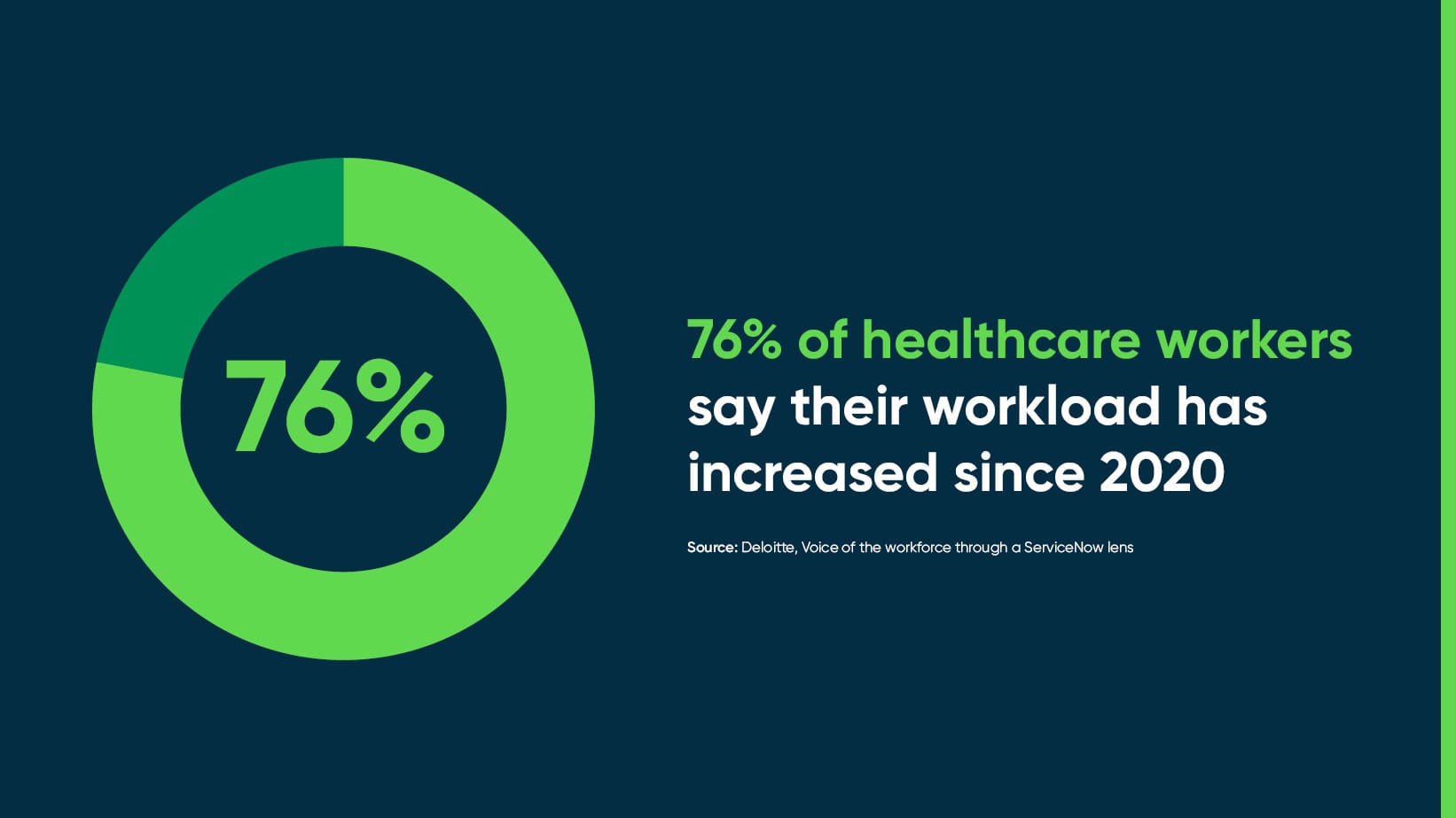
Administrative pressures are pushing our healthcare system and its people beyond capacity. 76% of healthcare workers say their workload has increased since March 2020.iii
When staff are over-burdened with administrative tasks, it impacts their work-life balance, as well as the time they have available to spend with patients. It is also an ongoing cause of frustration which affects the overall employee experience.
“Time is currency in health care. The more time you can release of the clinician from administrative work and give them time back, they can spend more time with patients delivering highest quality care,” says Dr Dhage.
Technology can help by:
- Automating everyday workloads and using generative AI for tasks such as writing patient admissions and referral letters or completing forms. In-built approval processes ensure sufficient checks and reviews are in place before any documentation is released.
- Automatically tracking and managing medical equipment maintenance and repairs, which can lead to enhanced availability of equipment.
- Bringing the right data together, including integration with electronic health records and other clinical application, which can deliver and more accurate insights, sooner.
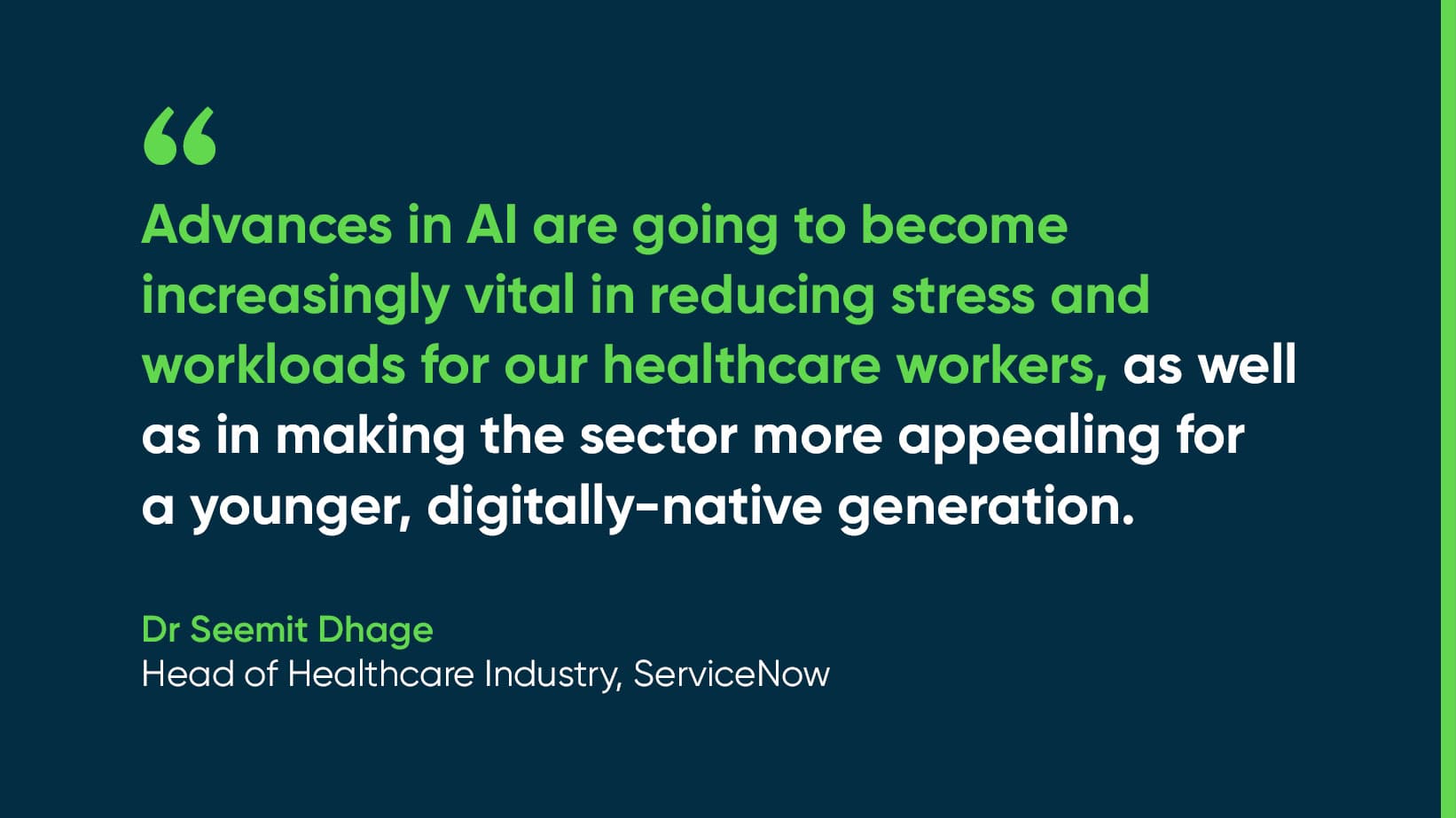
“Tools such as generative AI are becoming critical in healthcare as they can significantly streamline repeatable workloads and ensure clinicians can focus on more high-value tasks,” says Dr Dhage.
Keeping staff engaged
The workloads borne by our healthcare workers are patently unsustainable, driving many to seriously consider leaving the profession or cutting their hours.v 71% of frontline clinicians have considered changing their employment during the previous 12 months,vi and 2 in 5 healthcare workers have thought about reducing their hours to part-time.
Technology can help by:
- Providing employers with a clear view of the skills within the organisation, where gaps exist, more effectively and visibly develop existing employees to ensure they have those skills in the future.
- Using AI tools to support employees’ growth and skills development can empower healthcare workers to take charge of their career growth in a way that works for them.
- Speeding up the onboarding process and ensuring employees always have access to the information they need, like benefits, payroll information and HR policies.
- Providing employees with direct access to support at any time, ensuring they have a more streamlined experience.
- Using generative AI to communicate with employees in a way that is reflective of their sentiment and feedback.
Reducing the mental load
Healthcare work is taking its toll on employees’ mental health and wellbeing. Research shows those with less work experience, especially junior nurses, midwives and doctors, are affected to an even greater extent.
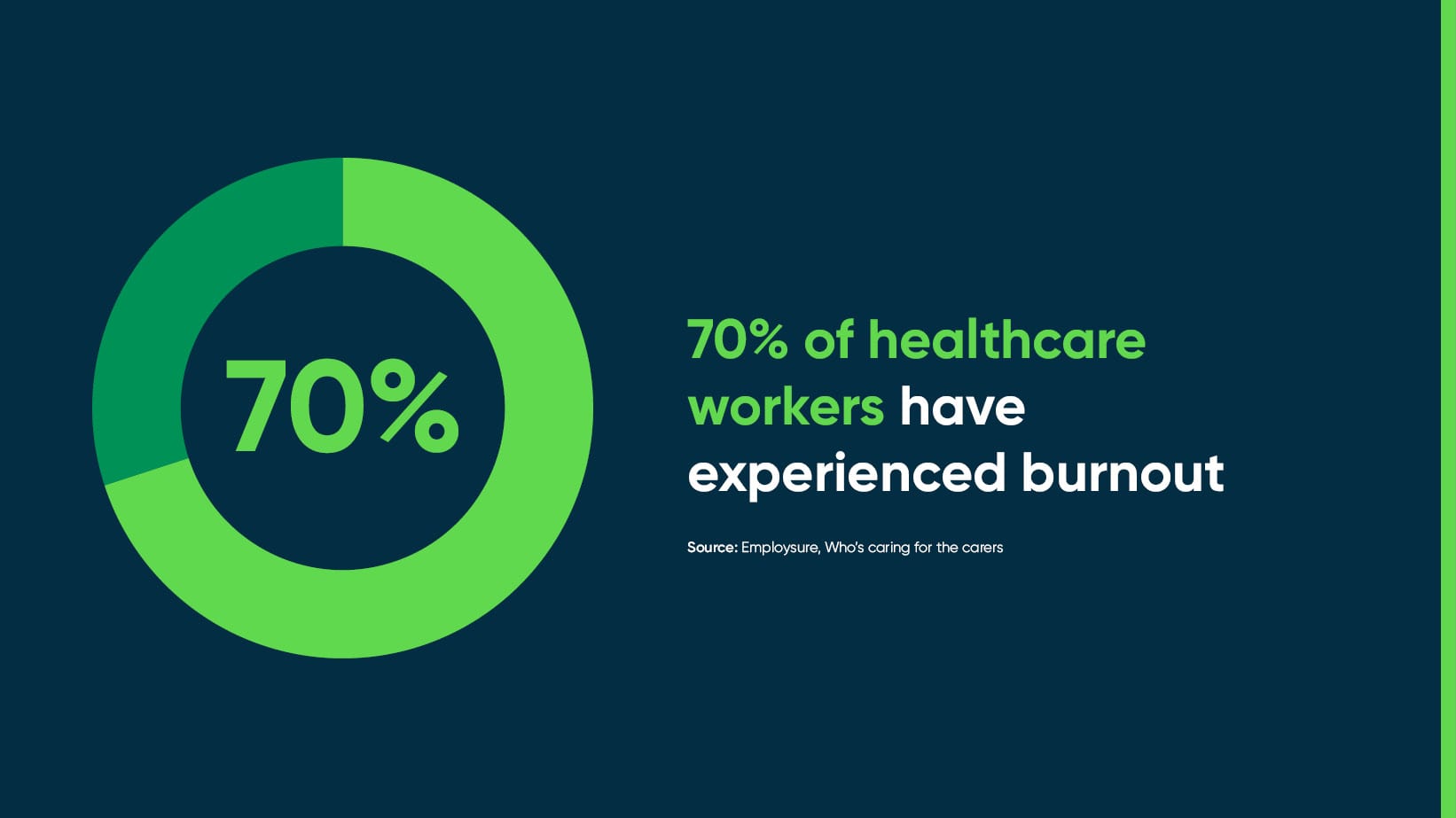
59.8% of Australian frontline healthcare workers have experienced anxiety; 70% have experienced burnout, and 57% have experienced depression.vii
Technology can help by:
- Enabling a holistic approach to supporting employees physically and emotionally, giving managers easy access to policies and content to support them in assisting their teams.
- Ensuring each employee has easy and simple access to information, from benefits plans and programs, to mental health support, parental leave and family resources.
- Using generative AI to streamline routine tasks, like writing referral letters, which can become a day-to-day burden for many healthcare workers.
“We simply can’t afford to let our healthcare workers reach the point of mental exhaustion. Technology is crucial in providing systems and processes to ensure they feel supported and empowered,” says Dr Dhage.
Ensuring healthcare workers’ concerns are heard
Many healthcare workers feel that there is little opportunity to provide feedback on their experience, and a lack of action on improving the workplace experience. Almost two in three healthcare workers question executive leaders’ engagement on critical issues.ix
Technology can help by:
- Providing in-built functionality to ensure healthcare workers concerns are listened to, with opportunities to capture feedback at every stage of an employee’s tenure. This may include gathering feedback after a payroll enquiry has been resolved, or during the onboarding or transfer process.
- Equipping managers with the information they need to take more proactive steps to improve the experience of their employees.
“Providing employees with tools and processes to enable them to more actively improve their own careers is vital in ensuring they have a more positive experience at work” says Dr Dhage.
How ServiceNow can help make healthcare better
ServiceNow is an innovative and intelligent platform that streamlines healthcare workflows and connects clinical teams—helping improve experiences for employees, without compromising on security or compliance.
The solution integrates every part of the healthcare organisation—front, middle and back-of-office—to ensure everyone has the information and the workflows they need to work as efficiently as possible. It also:
- Automates core workflows to speed up administrative tasks.
- Creates better connections between people and to information.
- Ensures employees feel valued and have access to learning and development tools to grow their career.
Learn more about how ServiceNow can create connections, streamline workflows and empower your people
i Insight Plus, How to solve Australia’s health workforce shortage, https://insightplus.mja.com.au/2023/18/how-to-solve-australias-health-workforce-shortage/
ii AIHW, Rural and remote Australia, https://www.aihw.gov.au/reports-data/population-groups/rural-remote-australians/overview
iii Deloitte, Voice workforce through ServiceNow lens, https://www.deloitte.com/au/en/alliances/servicenow/analysis/voice-workforce-through-servicenow-lens-2024.html
ivDeloitte, Voice workforce through ServiceNow lens, https://www.deloitte.com/au/en/alliances/servicenow/analysis/voice-workforce-through-servicenow-lens-2024.html
v Deloitte, Voice of the workforce through a ServiceNow lens, https://www.deloitte.com/au/en/alliances/servicenow/analysis/voice-workforce-through-servicenow-lens-2024.html
vi Deloitte, Voice of the workforce through a ServiceNow lens, https://www.deloitte.com/au/en/alliances/servicenow/analysis/voice-workforce-through-servicenow-lens-2024.html
vii Employsure, Who’s caring for the carers, https://employsure.com.au/blog/whos-caring-for-the-carers-healthcares-frontline-mental-health-problem
viii Employsure, Who’s caring for the carers, https://employsure.com.au/blog/whos-caring-for-the-carers-healthcares-frontline-mental-health-problem
ix Deloitte, Voice of the workforce through a ServiceNow lens, https://www.deloitte.com/au/en/alliances/servicenow/analysis/voice-workforce-through-servicenow-lens-2024.html