
Like many healthcare systems around the world, Australia’s is under enormous pressure. Clinicians and other healthcare employees are experiencing fatigue, while a complex regulatory environment and outdated work practices are adding to the strain. A rapidly changing technological landscape is also challenging the historical value proposition for skilled workers looking to choose a career in health.
Based on the current situation, Australia is predicted to face a shortfall of 100,000 nurses and 2,700 doctors by 2027.1
Healthcare costs in Australia have also risen by 40% over the last decade.2
To better understand and address these trends, ServiceNow, has partnered with Deloitte to harness cloud platforms and digital technology to help healthcare workers manage their workload, improve job satisfaction, and maintain wellbeing.
This blog summarises our top five recommendations, based on key insights from ServiceNow and Deloitte’s 2024 Voice of the Workforce Report.
- 76% of healthcare workers say their workload has increased since March 2020.
- 71% of frontline clinicians have considered changing their employing during the previous 12 months.
- 2 in 5 have healthcare workers have thought about reducing their hours to part time.
Source: Deloitte, The Voice of the Workforce
Challenge #1: Increasing workload
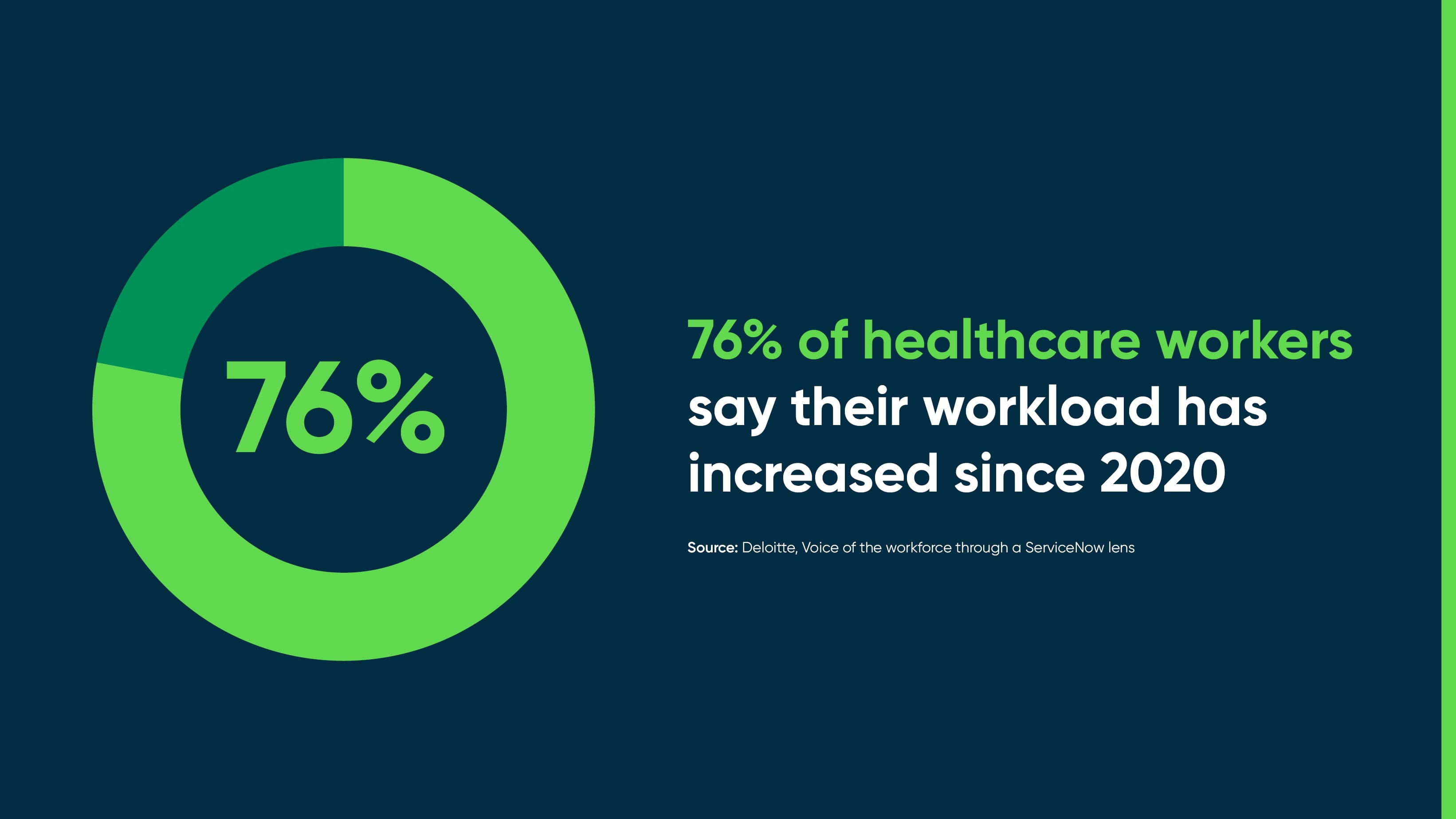
More than three-quarters (76%) of healthcare employees believe their workload has increased since March 20203. This is due to a range of factors, including increased administrative demands, the backlog of healthcare treatments due to the Covid pandemic, Australia’s ageing population, and the gradual rise in chronic disease.
Almost half (45%) of these employees attribute the increased workload to a change in demand for healthcare services.
These pressures are pushing our healthcare system and its people beyond capacity.
Frontline clinicians are struggling with the administrative burden. Most want these duties to be streamlined, allocated elsewhere, or avoided entirely to create more time for patient care.
Solution: Using technology to reduce admin
Technology lets clinicians be clinicians, taking away time spent on admin. Action needs to be taken to redesign ways of working and make the growing workload easier to manage. Smart, AI-led technology can play a critical role in enabling this by automating routine and mundane tasks.
For example, ServiceNow's automation can streamline procedures such as patient admissions, discharges, and transfers. Incident management tools can also help track and manage medical equipment maintenance and repairs, which can lead to enhanced availability of equipment. Integration with electronic health records (HER) and other clinical applications ensures a seamless flow of data and reduces duplicate data entry – all of which gives clinicians more time to spend with patients.
Challenge #2: People moving on
Many healthcare professionals say they are looking to leave the profession or cut their hours. 71% of frontline clinicians have considered changing their employment during the previous 12 months, and 2 in 5 healthcare workers have thought about reducing their hours to part-time3.
Solution: Understand and develop talent to keep employees in the fold
Healthcare workers need to know their employer is invested in their career.
Using technology like ServiceNow’s Skills Intelligence software, healthcare organisations can get a clear picture of the skills within their organisation today, determine where gaps exist, and more effectively adevelop existing employees to ensure they have those skills in future.
Consolidating employee data onto one platform also streamlines onboarding and provides employees with easy access to all the information they need, when they need it —like benefits, payroll information, and HR policies. Employees can connect quickly to the support they need at any time ensuring a smooth and streamlined employee experience.
Challenge #3: Psychological safety
Healthcare work is clearly taking its toll, with many survey respondents suffering physically and mentally because of high work demands and other stress. Those with less work experience, especially junior nurses, midwives and doctors, are affected to a greater extent in terms of their wellbeing and dissatisfaction.
Recent research by Monash University4 reveals the extent and seriousness of this problem:
- 60% of Australian frontline healthcare workers have experienced anxiety.
- 71% have experienced burnout.
- 57% have experienced depression.
- 22% gave experienced all three conditions at once.
Solution: Putting mental health and wellbeing on the agenda
ServiceNow enables a holistic approach to supporting employees physically and emotionally—giving managers easy access to policies and content to enable them to help employees. Each employee also has easy and simple access to information—from benefits plans and programs, to mental health support, parental leave and family resources.
With this proactive approach to wellbeing, frontline workers who are exposed to traumatic events can be protected with automated prompts to their line managers, as well as Employee Assistance program outreaches, ensuring intelligent care for those who care for us.
Challenge #4: Engagement
A lack of consultation is a sticking point with clinicians, with almost two in three healthcare workers questioning executive leaders’ engagement on critical issues.
To achieve purpose-led change, the healthcare sector must get the human factors right. Yet for now, there are few bespoke engagement and retention strategies that acknowledge the different motivators across generations, especially junior staff.
According to an Australian doctor writing for the Royal Australian College of General Practitioners, “healthcare organisations need to be accountable for the burnout of their workforce and acquire data on the benefit of any interventions applied."5
Solution: Connecting with employees through better listening and learning
Long gone are the days of annual feedback surveys. To engage employees, it’s imperative that organisations listen continuously, and especially during important moments. The ServiceNow platform has inbuilt functionality to support this—providing opportunities to capture feedback at every stage of an employee’s tenure. This may include gathering feedback after a payroll enquiry has been resolved, or during the onboarding or transfer process.
Equipped with this data, healthcare organisations can then take more proactive steps to improve—and measure—the experience of their employees.
Challenge #5: Trust
Research indicates that clinicians don’t feel executive leaders at their workplaces can be trusted to be transparent about employee satisfaction levels—pointing to cultural and leadership alignment gaps that need to be addressed.
This is crucial because sound leadership, an organisation’s culture, and the delivery of high-quality care, are inextricably linked.
Solution: Building transparency and belief in a digital world
Cultural reform of an organisation can make a big difference to trust levels from within. ServiceNow can help with this by capturing real data on which areas of the employee experience need work—and making this broadly accessible to all. The ServiceNow platform can also support regular surveying and publishing of data to showcase possible improvements or areas that still require attention from management.
Technology plays a central and crucial role in reinventing Australian healthcare, and alleviating the burden on healthcare workers.
The ServiceNow platform can deliver the automation, efficiency and insights which healthcare organisations desperately need in today’s environment—elevating the experience for both workers and patients.
1 InSight+, Australasian Medical Publishing Company: How to solve Australia’s health workforce shortage
2 Medical Technology Association of Australia: Breaking Barriers to Deliver
3 Deloitte: Voice of the Workforce Through a ServiceNow Lens 2024
4 Employsure: Who’s Caring for the Carers?
5 Royal Australian College of General Practitioners: Why Australia needs a systematic response to burnout